News

Bird Tower, Mietoinen Bay Area, 2022
#fieldrecordings #grain #Lo-Fi #Saarifellow #Saariresidency
Recent and ongoing work:
PROFONATION – Armonviitta, a video/sound art piece for the Chapel of Silence (Kamppi, Helsinki, FIN). Premiere 9.10.2026
Sound design on the performing arts piece Ex Ruina Floreat, Teater Viirus, Helsinki. Premiere 18.10.2025.
Sound design on the big stage sound design of Jäniksen vuosi, Finnish National Theatre, Helsinki. (Premiere 16.10.2024).
Sound art piece & two collaborative pieces have been opened for public as part of permanent exhibition of Finnish Forest Museum LUSTO
Rajakangas has started to work as a university lector in Sound Design Programme at Theatre Academy, University of Arts, Helsinki in November 2023.
About
Hanna Rajakangas (b. 1979) is a sound artist and designer based in Helsinki, Finland. Her multidisciplinary work revolves around sound and voice. She works in the fields of artistic research, performing arts, sound art, field recordings, acoustic ecology and sound installations. Since 2022 she has been teaching at the University of Arts Helsinki. In November 2023 she started to work there as a lector in sound design programme. At first as an invited lector for a period of nine months, then in March 2024 Rajakangas was selected for the permanent position.
PROFANATION (Profanaatio) is an artistic concept developed by Moisander & Rajakangas (Juhana Moisander and Hanna Rajakangas). The work explores the phenomenon of church spaces that are being vacated and transformed, as sacred places take on new functions within society, often in response to the economic pressures faced by congregations.
Rajakangas’ ongoing artistic research in the doctoral program of the University of the Arts, Theatre Academy, explores the affectivity of the performer's voice from the perspective of sound design.
Her work has been supported e.g- by Kone Foundation, Aalto Digital Creatives Art&Tech, TTOR / Uniarts Helsinki, Svenska Kulturfonden, Saaren Kartano.


©2022, Jussi Virkkumaa, Saari Residency
Soundworks


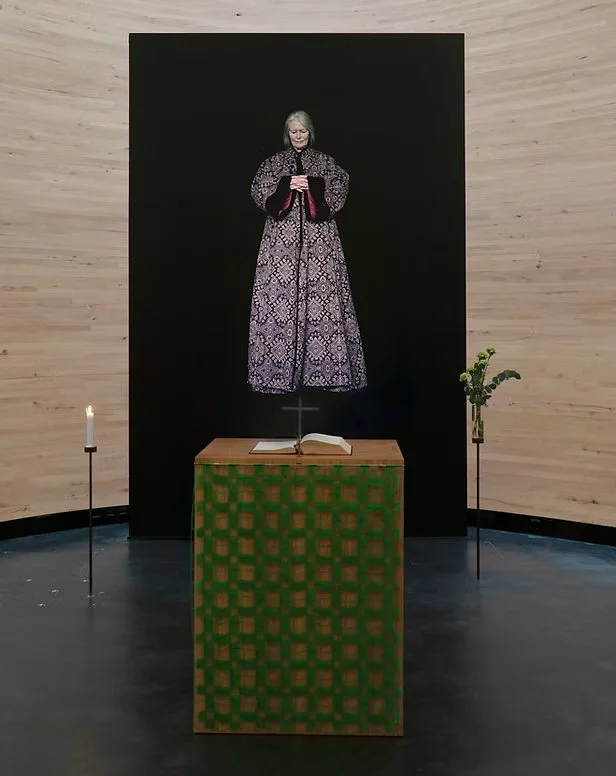
PROFONAATIO – Taide tyhjenevissä kirkkotiloissa / Profanation: Art in Emptying and Transitioning Church Spaces
Armonviitta on Moisander & Rajakankaan yhteistyönä toteutettu videoinstallaatio Kampin kappeliin Helsingissä. Teos viittaa kristilliseen ikonografiseen kuvastoon, läntiseen Mater Misericordiae- ja itäiseen Pokrova-perinteeseen, joissa Neitsyt Maria levittää viittansa suojaksi yhteisön ylle. Installaatio lukee tätä perinnettä uudelleen ja kysyy, mitä suoja, yhteisyys ja pyhä voivat tarkoittaa tässä ajassa.
Kirkkotilojen arkkitehtuuri, muoto, materiaalit ja akustiikka on suunniteltu pyhän kohtaamiseen. Tilojen sulkeminen ja uudelleenkäyttö on laaja ilmiö, joka kiinnitti huomiomme. Mitä tapahtuu pyhälle, kun tilan käyttötarkoitus määritellään uudelleen? Onko mahdollista purkaa pyhä tilasta, jonka muoto ja käyttötarkoitus on sille omistettu?
Kampin kappelin kohtalo on avoin. Tämä epävarmuus on Armonviitta-installaation lähtökohta. Tila, joka on rakennettu suojaksi ja kohtaamiseen, saattaa menettää virallisen tehtävänsä, mutta ei välttämättä sitä tapaa, jolla ihmiset ovat oppineet siinä olemaan. Pyhä ei tässä ole ominaisuus, joka joko on tai ei ole tilassa läsnä. Se syntyy suhteessa tilan merkityksiin ja siihen kiinnittyneisiin materiaalisiin ja yhteisöllisiin kytköksiin, yhteisön paikalle antaman merkityksenannon kautta. Kirkkotila pyytää tulijaltaan huomiota, hidastumista ja pysähtymistä. Kun alkuperäinen kehys väistyy tai muuttuu, tämä suhde jää avoimeksi.
Teos jatkaa kappelin hengellistä minimalismia. Videoprojisointi ja tilaan sijoitetut kaiuttimet asettuvat osaksi kaarevaa, puupintaista tilaa, ja äänimaisema syventää viittaa kantavan hahmon sisäistä maisemaa. Suojelevan Marian hahmossa suoja, yhteisö ja tila ovat kietoutuneet yhteen vuosisatojen ajan. Kampin kappelissa hahmo ei enää kanna institutionaalista lupausta, mutta se kantaa yhä kysymystä: kuka mahtuu viitan alle?
Laajempi artikkeli Armonviitta teoksesta ja tyhjenvistä kirkkotiloista:
PROFANAATIO- Taide tyhjenevissä kirkkotiloissa (Juhana Moisander)
Mantle of Mercy is a video installation created by Moisander & Rajakangas for the Kamppi Chapel in Helsinki. The work draws on Christian iconography, specifically the Western Mater Misericordiae tradition and the Eastern Pokrova tradition, in which the Virgin Mary spreads her mantle over the community as protection. The installation rereads this tradition and asks what shelter, community and the sacred might mean today.
The architecture, form, materials and acoustics of church spaces are designed for an encounter with the sacred. The closure and repurposing of these spaces is a widespread phenomenon, and it caught our attention. What happens to the sacred when the purpose of a space is redefined? Is it possible to strip the sacred from a space whose very form and purpose were dedicated to it?
The future of the Kamppi Chapel is uncertain, and this uncertainty is the starting point of Mantle of Mercy. A space built for shelter and encounter may lose its official function, but not necessarily the way people have learned to be in it. Here the sacred is not a quality that is either present in a space or absent from it. It arises in relation to the meanings of the space and to the material and communal ties attached to it, through the meaning a community gives to a place. A church asks those who enter to pay attention, slow down and pause. When the original framework recedes or changes, this relationship is left open.
The work continues the chapel’s spiritual minimalism. The video projection and loudspeakers become part of the curved, wood-clad space, and the soundscape deepens the inner landscape of the figure who bears the mantle. In the figure of the protecting Mary, shelter, community and space have been intertwined for centuries. In the Kamppi Chapel the figure no longer carries an institutional promise, but it still carries a question: who fits beneath the mantle?
Artistic Research
Hanna Rajakangas is currently conducting artistic research at the University of the Arts Helsinki, Finland. Her twenty years of professional experience lie at the intersection of two professions; she is a performer / a cappella singer and a sound designer in the performing arts. Current research focuses on the affectivity produced jointly by the performer's use of voice, spatial phenomenology, and performer agency. In order to study the affectivity of the voice in theatrical contexts, rather than studying the semantics of language, the research explores voice’s paralinguistic materiality. As part of addressing these research questions, Rajakangas (in collaboration with sound technologist and composer Josué Moreno) developed a responsive, time- and space-specific interface, an XR multi-channel sound concept for the theatre arts stage. The concept, called Theatrical Voice, was a selected winner of the Aalto University Finland / Digital Creatives, Art & Tech Open Call 2022.
Keywords for the ongoing research are: voice and sound studies, phenomenology, agency, affect theory, process of becoming, cyborg body, cyborg theory, paralinguistics, prosody, immersive sound system, artistic research
Some themes that are currently related to the research and artistic work:
• Tuning in • Inherited Listening • Becoming Through Voice • Agency & Theatrical Speech • Ecology of Sound and Voice • Sympoiesis / Cyborg Theory • Extended Voice • Ensemble playing • Collaborative Sonification
Gallery: work – atmospheres & environments


